
Does this job need an AI agent?
A reliable workflow and an adaptable AI agent solve different problems. The most useful business system may combine them, with clear boundaries between interpretation and action.
Use a defined workflow when the steps and rules are known. Consider an agent when the task needs the model to choose some steps or tools as it discovers information. Keep approvals, access controls and consequential record changes explicit whichever approach you choose.
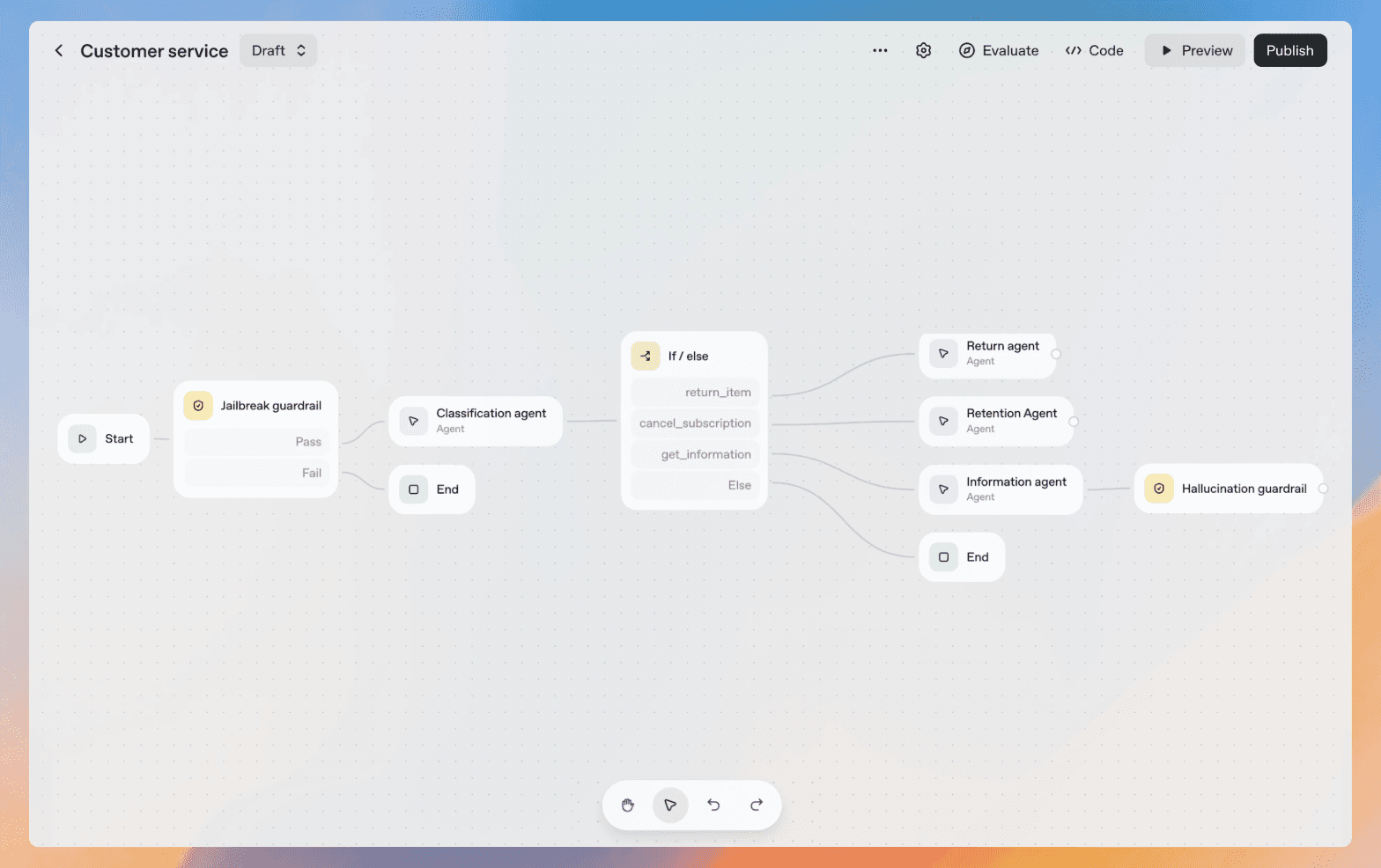
Who chooses the next step?
A conventional automation follows a designed sequence: receive a form, validate its fields, find a contact and create a task. It can branch using rules, but those branches are defined in advance. It can also include an AI step, such as classifying a message, without becoming an open-ended agent.
An agent can choose tools or intermediate steps while pursuing a goal. Anthropic describes this distinction as predefined code paths for workflows versus model-directed processes for agents, and recommends starting with the simplest approach that meets the task.
| Task | Starting approach | Reason |
|---|---|---|
| Create a CRM task from a valid form | Rules-based workflow | Known inputs, validation and destination. |
| Classify an email, then route it | Workflow with an AI step | Interpretation varies; routing rules can remain fixed. |
| Find a policy answer with evidence | Retrieval-based assistant | The goal is an answer grounded in approved sources. |
| Investigate a variable operational exception | Consider a bounded agent | The next source or tool may depend on what is discovered. |
Follow an enquiry through the alternatives
If a web form already provides the service, location and customer details, a rule can route the enquiry. Asking a model to decide the destination may add cost and variability without adding value. Validate the fields and use the routing rules your team has agreed.
If the request arrives as a long free-text email, a model might extract a summary and suggest a category. Keep the permitted categories explicit, validate the output and route ambiguous cases for review. The rest of the workflow can remain deterministic.
If resolving the request requires investigating several sources in a sequence that cannot be known upfront, an agent may help. Define which tools it can use, how long it can work and the evidence it must return. Let a person approve a proposed action before it changes an important record.
Account for the cost of flexibility
Every additional tool call can introduce latency, usage charges and another failure point. A process that works on one example may behave differently when information is missing or a tool returns an error. Evaluate complete task outcomes, including incomplete runs and review effort.
Define stopping conditions before the pilot: a maximum number of steps, a time or usage budget and a clear handover when the system cannot finish. The user should see what was attempted and what remains unresolved, rather than a confident completion message unsupported by the actual result.
- Measure successful completion of the whole task.
- Record model and tool usage, not just the first response time.
- Test missing records, unavailable systems and misleading inputs.
- Make repeated actions and partial completion visible.
Separate investigation from permission to act
Reading an order record is different from refunding it. Drafting a message is different from sending it. Design those permissions separately, and test that the interface and underlying tools enforce the distinction.
A useful first agent can be read-only. It gathers evidence and prepares a recommendation while your team retains control of changes. Expand responsibility only when evaluation and operational experience justify the next scope.
Specify the job before the architecture
Write down the trigger, inputs, acceptable output, available tools and situations that require a person. Ask which steps genuinely need interpretation or investigation and which can be expressed as rules.
Then compare the simplest workable design with the more flexible alternative using the same test cases. Choose the approach that gives your team a useful, maintainable result at an acceptable cost.
Further reading
The technical distinctions in this guide draw on these primary sources. The decision questions and business examples are Dragon AI’s practical guidance.